From Framework to Practice: Why Teacher Training Matters for Digital Well-being
Digital well-being cannot be strengthened through rules and technology alone. Teachers need practical opportunities to reflect on their own digital habits, understand students’ experiences, and translate well-being principles into everyday classroom decisions.
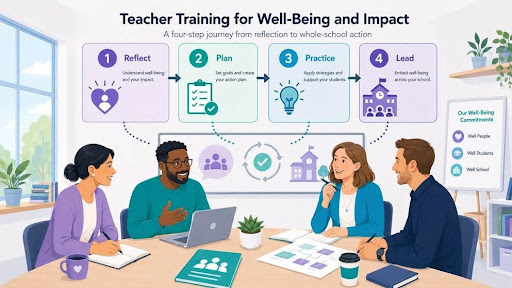
Illustration generated using OpenAI image-generation tools and refined by the UCD project team
Digital well-being begins with everyday practice
Digital technologies are now woven into almost every part of school life. They shape how teachers plan lessons, communicate with colleagues and families, assess learning, and support students. For learners, digital spaces influence attention, emotions, friendships, confidence, and their sense of progress.
This means that digital well-being is not a separate topic that can be addressed through a single lesson or an annual online-safety event. It develops through the routines, expectations, relationships, and choices that surround technology every day. A platform may be technically safe and educationally useful, yet still create overload, distraction, frustration, or exclusion if it is introduced without attention to how people experience it.
Teachers are therefore central to digital well-being. They are the people who notice when students lose focus, feel left behind, become anxious about an online task, or flourish through creative and collaborative digital work. They are also managing their own digital workload, communication pressures, and professional boundaries.
A framework becomes useful when teachers can apply it
The PERMA-Digital approach brings together the PERMA model of well-being — Positive Emotion, Engagement, Relationships, Meaning, and Accomplishment — with the European DigComp and LifeComp competence frameworks. Together, these perspectives connect digital skills with emotional, social, and personal development.
However, a framework only creates change when educators can relate it to real situations. What does engagement look like during a digital lesson? How can a teacher distinguish productive challenges from digital frustration? Which tools strengthen relationships, and which may unintentionally isolate learners? How can digital activities help students experience meaning and accomplishment rather than simply complete another task?
Professional learning gives teachers space to explore these questions, compare experiences, and test practical responses. The purpose is not to prescribe one perfect way of using technology. It is to help educators make more intentional decisions, based on their students, their curriculum, and their school context.
Moving beyond awareness
Effective training should move progressively from understanding to action. Teachers first need a shared language for discussing well-being and digital well-being. They then need tools to assess current practice, identify priorities, and set realistic goals.
Reflection is particularly important. Educators may recognise that constant notifications are affecting concentration, that too many platforms are increasing workload, or that some students participate less confidently in digital spaces. Structured reflection helps turn these observations into a clear area for improvement.
From there, teachers can develop small, achievable actions: introducing a short emotional check-in before and after a digital task; agreeing clearer communication boundaries; selecting tools with accessibility and emotional safety in mind; or redesigning an activity to include collaboration, choice, and meaningful feedback. These changes may appear modest, but repeated consistently they can reshape the learning experience.
Training that connects the individual, classroom, and school
Digital well-being is influenced by both internal and external factors. Students and teachers develop skills such as self-regulation, communication, critical thinking, and responsible digital use. At the same time, their experiences are shaped by school policies, curriculum expectations, infrastructure, workload, family practices, and the wider digital culture.
This is why teacher development needs to connect three levels of action. At the individual level, educators reflect on their own well-being and professional habits. At classroom level, they design activities, routines, and relationships that support students. At the whole-school level, staff work toward shared expectations and coordinated action.
When these levels reinforce one another, digital well-being becomes part of school culture rather than the responsibility of one enthusiastic teacher. Shared language and practical tools also make it easier for colleagues to collaborate and for schools to involve families in consistent, constructive conversations.
The next step for PERMA-Digital
As the PERMA-Digital project moves from framework development into training and capacity building, the focus is on making the research practical. The teacher-training programme is being developed as a connected pathway: from foundational understanding, through reflection and classroom planning, to sustainable whole-school implementation.
The aim is to support educators not simply to use more technology, or less technology, but to use it more purposefully. Digital learning should help students feel safe, engaged, connected, capable, and able to understand why their learning matters.
By investing in teachers’ confidence and professional judgement, schools can move beyond reactive responses to digital challenges. They can begin to create learning environments where technology supports both educational goals and human flourishing.
Learn more: PERMA-Digital project website