Four Modules, One Journey: Supporting Digital Well-being Across the Whole School
The PERMA-Digital teacher-training package offers a practical journey from understanding digital well-being to designing classroom activities and building a sustainable whole-school culture.
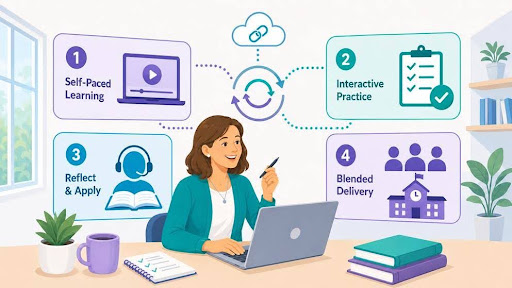
Illustration generated using OpenAI image-generation tools and refined by the UCD project team.
From a shared understanding to coordinated action
Schools increasingly recognise that digital well-being is about much more than screen time or online safety. It includes how technology affects emotions, attention, relationships, professional workload, participation, and the sense of meaning and achievement that teachers and students experience. The challenge is turning that broad understanding into practical action. Educators need a structured pathway that starts with the foundations, supports personal and professional reflection, and leads toward classroom and school-level change. The PERMA-Digital training programme has been designed around that progression. The programme consists of four connected modules. Each module builds on the previous one, while remaining adaptable to different school contexts and levels of experience.
Module 1: Building the foundations
The first module introduces well-being and digital well-being in education. Participants explore the five PERMA elements — Positive Emotion, Engagement, Relationships, Meaning, and Accomplishment — and consider how they appear in digital learning experiences. The module also connects PERMA with DigComp and LifeComp. DigComp highlights areas such as information and data literacy, communication, content creation, safety, and problem solving. LifeComp brings personal, social, and learning-to-learn competencies into the picture. Their integration helps educators see digital well-being as a combination of competence, emotional awareness, relationships, and purposeful participation. Activities encourage teachers to compare positive and negative effects of technology and to reflect on the internal and external factors influencing digital well-being in their own settings.
Module 2: Turning reflection into an action plan
The second module moves from concepts to practice. Teachers use digital well-being indices and reflection tools to consider their own experiences and those of their students. They identify an area for development, explore possible root causes, and formulate a realistic goal. The focus is not on judging whether someone is “good” or “bad” at digital well-being. It is on identifying one useful priority and creating a manageable plan. Teachers explore SMART goals, personalised action planning, self-reflection logs, digital boundaries, classroom observation, and strategies that can support students throughout the school year. This approach recognises that improvement is an ongoing process. A plan can be tested, reviewed, and adapted as teachers learn more about what works for them and their students.
Module 3: Designing learning with well-being in mind
The third module focuses on pedagogy and classroom design. Participants examine how teaching approaches and digital tools can support, or undermine, positive emotion, engagement, relationships, meaning, and accomplishment. Teachers are invited to evaluate digital tools not only for functionality, but also for emotional safety, inclusion, healthy use, focus, and collaboration. They then use lesson-plan examples and templates to design purposeful classroom experiences. Example activities include exploring hope, empathy, and digital kindness. The module also looks beyond formal lessons, supporting educators to design extracurricular and home-linked experiences that promote balance, social connection, play, and meaningful participation.
Module 4: Creating a sustainable whole-school culture
The final module brings individual and classroom work into a wider school strategy. Participants explore how a shared vision and common values can guide digital practices across leadership, teaching, communication, family engagement, and student support. Tools for needs analysis, strategic planning, objective setting, and implementation help schools move from broad intentions to coordinated action. The module also emphasises the role of families and communities. Consistent expectations are easier to build when schools and families can discuss digital habits openly and work toward shared goals. A whole-school approach does not mean that every classroom must use technology in exactly the same way. It means that decisions are guided by a coherent understanding of well-being, and that staff, students, and families know what the school is trying to achieve.
Flexible resources for different learning contexts
The programme includes presentations, activity sheets, reflection prompts, assessment questions, planning templates, well-being indices, lesson examples, observation tools, and whole-school resources. Trainers can adapt the timing and methods to the needs of their participants while maintaining the central learning outcomes. Interactive online versions of the four modules also support flexible professional learning. They can be used for preparation before a workshop, revision afterwards, self-paced study, or blended delivery combining independent learning with facilitated discussion and local planning. This flexibility is important because schools begin from different places. Some may be developing a shared vocabulary for the first time. Others may already have strong digital policies but want to strengthen emotional well-being, relationships, or meaningful participation. The modular structure allows each school to connect the material with its own priorities.
A practical foundation for long-term change
The intended outcome of the training is not a one-off collection of activities. It has increased capacity: teachers who can recognise digital well-being needs, select and adapt appropriate strategies, evaluate digital tools more thoughtfully, and contribute to a shared school approach. When educators are supported to reflect, experiment, and collaborate, digital well-being becomes more concrete. It can be seen in clearer boundaries, more inclusive learning design, healthier communication, meaningful classroom activities, and school plans that connect values with everyday practice. The four modules provide a pathway for this work — from awareness, to personal application, to pedagogical design, and finally to sustainable whole-school action.